

Electives
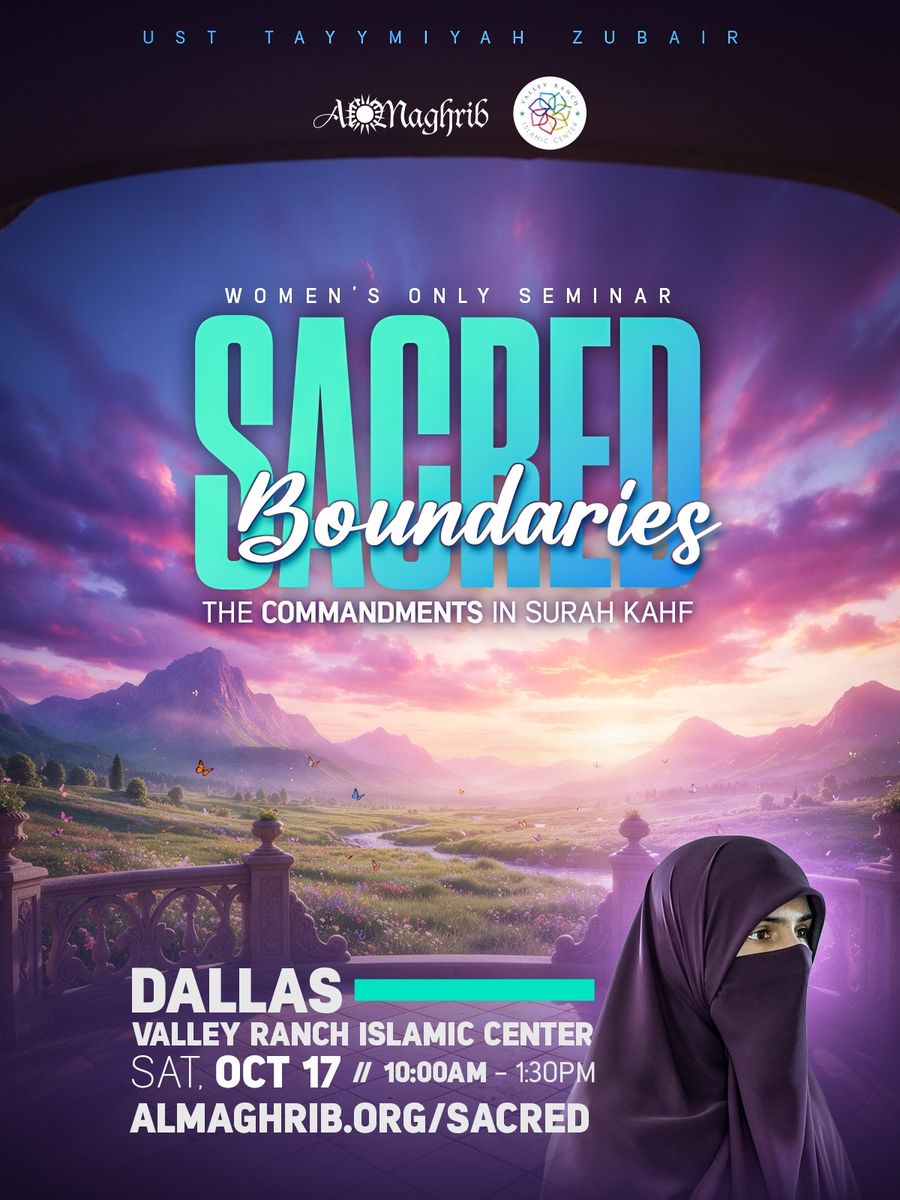
Sacred Boundaries (Sisters only)
The Commandments in Surah Kahf
 Ust. Taimiyyah ZubairInstructor
You hear it everywhere: the Deen is “too restrictive.” Yet within Surah al-Kahf, Allah and His righteous servants use the word lā ten times as a prohibition. Ten boundaries a believer does not cross, not to hold you back, but to raise your character. Join Ust. Taimiyyah Zubair for one morning with all ten.
What you'll walk away with
- Do not waste yourself on meaningless debate (18:22)
- Do not seek guidance from the wrong sources (18:22)
- Do not speak of the future without in shā’ Allāh (18:23-24)
- Do not overlook sincere believers for worldly status (18:28)
- Do not follow those who are heedless of Allah (18:28)
- Do not judge before the full picture is clear (18:70)
- Do not be quick to blame (18:73)
- Do not make matters difficult for others (18:73)
- Do not persist in a broken relationship, and part with dignity (18:76)
- Do not associate anyone in the worship of your Lord (18:110)
Boundaries that don’t hold you back. They raise you.
“Retreat to the cave. Your Lord will spread out for you of His mercy…” (Surah al-Kahf 18:16)
You know it’s all part of the test. Still, the negativity gets to you, and maybe at some point you’ve asked yourself: why are there so many restrictions in Islam?
Consider the name of the surah itself. The young believers never saw the cave as a prison. They saw it as refuge, and Allah spread His mercy over them inside it. That is what these boundaries are: shelter.
Read together, the ten prohibitions of Surah al-Kahf form a complete framework for refining your mind, your character, your relationships and your worship. The next time someone asks why there are so many restrictions, you’ll have an answer. More importantly, you’ll have it for yourself.
Ust. Taimiyyah Zubair
Instructor
Ust. Taimiyyah Zubair specialises in Quranic studies, with a particular focus on tafsir and the linguistic analysis of the Quran. She studied under her parents and mentors, Dr. Idrees Zubair and Dr. Farhat Hashmi, founders of Al Huda International, and has taught Arabic grammar, hadith and fiqh at Al Huda Institute.
With more than a decade of teaching experience across local and international settings, she brings a rare combination of precision with the Arabic text and warmth in the classroom. She is one of AlMaghrib’s female instructors, and her seminars for sisters consistently leave students reading the Quran differently.
There is more about this seminar on its own page.
Learn more about this seminar