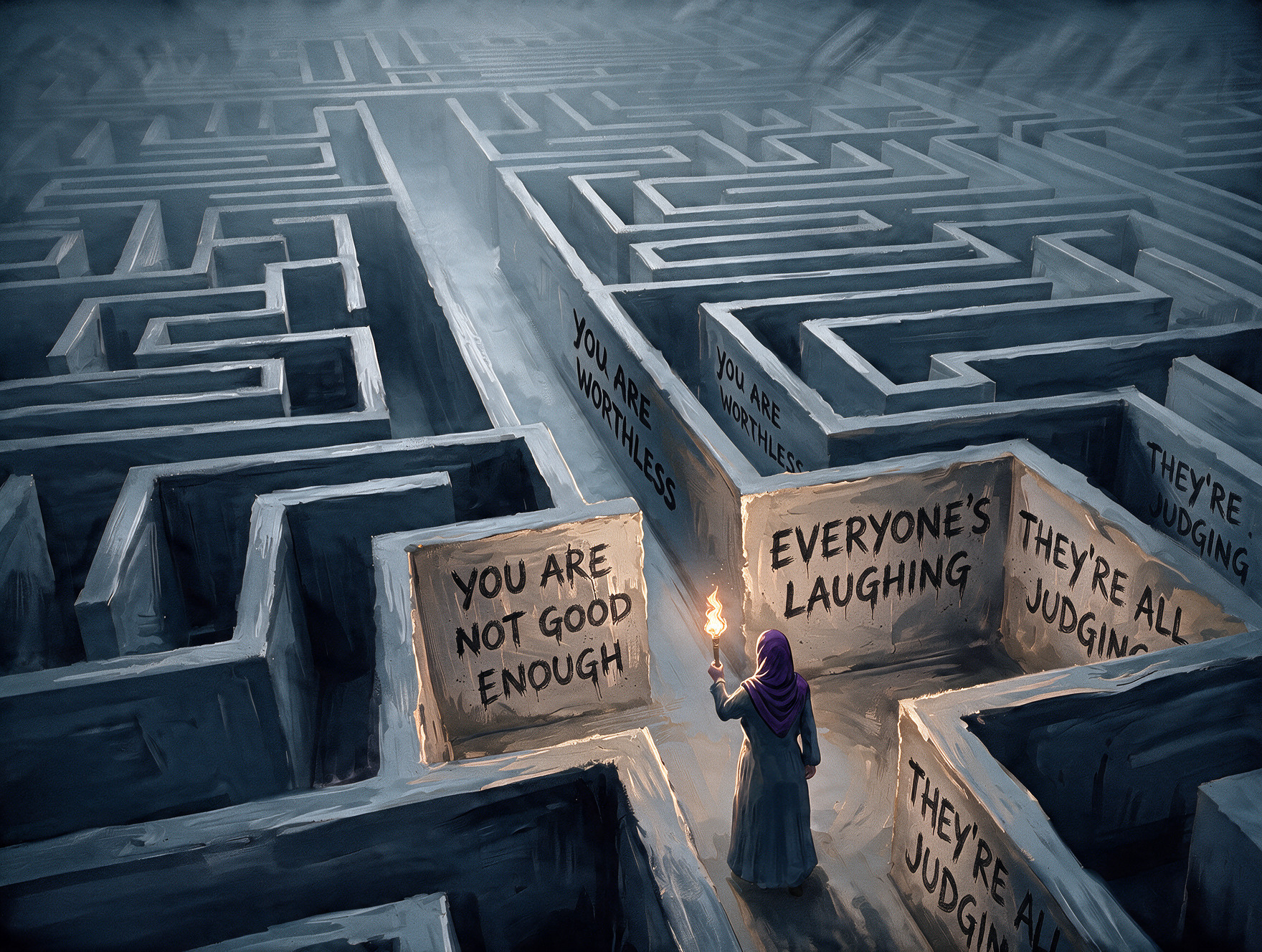
Some experiences make the heart pound and the palms sweat.
A hard conversation, a big exam, a phone call that goes unanswered for too long. The discomfort can feel so intense that the only thought left is how to make it stop.
A lot of Muslims feel guilty about anxiety on top of the anxiety itself. There is a common assumption that if someone truly trusted Allah, they wouldn’t feel this way at all. Sometimes anxiety can show up as a lack of trust in Allah. But in general, anxiety is something every person experiences at different points in life. It is an emotion Allah created human beings with, and it is normal.
The real question is what a person does with it.
A Companion Overwhelmed by Worry
It is reported that the Prophet ﷺ once entered the masjid and found a man from the Ansar, Abu Umama رضي الله عنه, sitting there. It wasn’t time for prayer. It was an odd time for anyone to be sitting in the masjid, and the Prophet ﷺ noticed. He could probably see it on his face. So he asked him, “O Abu Umama, why do I see you sitting in the masjid when it is not time for prayer?”
Abu Umama answered honestly: he was overwhelmed by worries and by debts.
Look at how the Prophet ﷺ responded. He didn’t say, “Come on, you’re a believer, there’s no space for anxiety in this faith.” He didn’t dismiss him at all. He acknowledged what Abu Umama was going through, and then he gave him something practical to do: “Shall I not teach you words which, if you say them, Allah will remove your worry and settle your debt?” Then he taught him to say, morning and evening:
اللَّهُمَّ إِنِّي أَعُوذُ بِكَ مِنَ الْهَمِّ وَالْحَزَنِ، وَأَعُوذُ بِكَ مِنَ الْعَجْزِ وَالْكَسَلِ، وَأَعُوذُ بِكَ مِنَ الْجُبْنِ وَالْبُخْلِ، وَأَعُوذُ بِكَ مِنْ غَلَبَةِ الدَّيْنِ وَقَهْرِ الرِّجَالِ
“O Allah, I seek refuge in You from worry and sadness. I seek refuge in You from inability and laziness. I seek refuge in You from cowardice and stinginess. And I seek refuge in You from being overwhelmed by debt and from the oppression of men.” (Narrated by Abu Saʿid al-Khudri رضي الله عنه, Sunan Abi Dawud)
Abu Umama said that he did this, and Allah removed his worry and settled his debt.
What started as one man’s anxiety became a gift, for him and for every Muslim who has said these words since. Sometimes the biggest struggles yield the most amazing gifts, and seeing them that way makes them easier to bear.
The Prophet ﷺ himself, the most beloved and most perfect of human beings, would often seek refuge in Allah from worry and grief (narrated by Anas ibn Malik رضي الله عنه, Sahih al-Bukhari). And it is interesting that the two are paired together. Grief looks to the past: regrets, sadness, things that already happened. Anxiety looks to the future: everything a person is afraid might happen. If one of the righteous companions struggled this deeply, and the Prophet ﷺ regularly asked Allah for protection from it, then no one is above a struggle with anxiety.
Everyday Worry and Clinical Anxiety
Anxiety is incredibly common. During the COVID pandemic, anxiety rates shot up. Everybody was anxious, and people who had finished therapy found themselves back in it. Around a third of adults still report struggling with intense anxiety, and young people were hit especially hard.
So how can someone tell the difference between ordinary worry and something more serious?
The average person spends about an hour a day on some kind of worry. “I forgot the sour cream for the tacos tonight, when am I going to get to the grocery store?” “I’m running late for my meeting.” Small, normal, daily anxiety.
A person with clinical anxiety might spend around five hours a day worrying, and the worry looks different. They ruminate. Their thoughts go around and around in a spiral. They replay a conversation with a friend: “Why did I say that? Was she offended? Maybe that’s why she hasn’t answered my text.” They jump to the worst-case scenario: “He’s not picking up the phone. What if he got into a car accident? How would I even live as a widow?”
Some describe anxiety as an endless loop of negative thoughts. Others feel it physically, as an uncomfortable feeling in the gut. At its core, anxiety is an intense feeling of discomfort, and almost all of it is tied to some kind of fear: fear that someone won’t come home, or fear of walking into a meeting late with everyone already seated and feeling embarrassed.
False Refuges
That discomfort is hard to tolerate, so the natural reaction is to get rid of it. The moment the butterflies start and the heartbeat speeds up, the mind goes straight to “How do I make this feeling stop?”
But what you resist persists. When a person constantly tries to escape an uncomfortable feeling, it comes back in different ways, and often in worse ways.
The things people reach for in those moments can be called false refuges: anything that provides temporary relief from discomfort. Every person wants to feel safe, protected, and loved, so it makes sense that they would grab whatever offers that feeling quickly. A false refuge gives a temporary sense of comfort and security, and avoiding the problem feels so much safer. But the longer someone lives inside that refuge, the more problems they find there, and the more suffering it causes.
False refuges are everywhere:
- Doom scrolling. Scroll, scroll, scroll, anything to stay distracted.
- Netflix binges, or getting lost in a book to avoid what needs facing.
- Productive procrastination. Cleaning the entire room the night before a final. The room is clean, which is nice, but there is now less time to study, and the studying still has to happen.
- Reaching for the phone the second it gets uncomfortable. Waiting alone at a restaurant for a friend to arrive feels awkward, so out comes the phone.
- People pleasing. Saying yes to everything to avoid the discomfort of someone being unhappy. It leads to burnout and resentment.
- Avoiding dua. Some people stop asking Allah for something because they are afraid of being disappointed.
Picture a wife who texts her husband: “When you get home, let’s finish that conversation from last time. I know it got heated, but I really want to resolve it.” He replies, “Sure.” Then he stays late at work, finding more and more to do. When he finally gets home, they never have the conversation. Instead, they fight about the fact that he avoided it. That is a false refuge: temporary relief that causes more pain in the end.
And modern life is built for false refuges. So much of what people have access to every day exists to help them avoid feeling uncomfortable.
The Refuge That Cost Everything
The Islamic tradition shows false refuges too, and one of the most painful examples is the death of Abu Talib, the uncle of the Prophet ﷺ.
As Abu Talib lay dying, the Prophet ﷺ was at his side, and so were Abu Jahl and Abdullah ibn Abi Umayyah, two men deeply tied to Quraysh and completely unwilling to leave their tribal loyalties. The Prophet ﷺ pleaded with his uncle: “My uncle, just say la ilaha illa Allah, a word I can use to testify for you before Allah.” Just say it. Please, just say it.
The other two turned to Abu Talib and played on his pride: “Will you abandon the religion of Abd al-Muttalib?” Would he really turn his back on his father, his tribe, his forefathers? The Prophet ﷺ kept asking, and they kept repeating their question, until Abu Talib gave his final answer. He would stay on the religion of Abd al-Muttalib. He never said la ilaha illa Allah (narrated by al-Musayyab ibn Hazn رضي الله عنه, Sahih al-Bukhari and Sahih Muslim).
This was an immense loss for the Prophet ﷺ. Abu Talib had protected and supported him for years and had a very special place in his heart. Anyone who has embraced Islam while their family hasn’t knows how painful this kind of loss is. When a beloved relative passes away without ever saying the shahada, it is a double loss: they are lost in this life and in the next.
But look at what held Abu Talib back. He was so uncomfortable with the thought of people looking down on him that, even on his deathbed, even if some part of him felt Islam was true, he was willing to risk the entire hereafter for a false refuge: his standing in the eyes of people who, in the end, didn’t matter.
How often do people make decisions the same way, based on discomfort and on “What will they say?” It is a familiar theme in Muslim communities: “You can’t do that, people will talk.” But what about doing it, or not doing it, for the sake of Allah? Doesn’t He have more right to be feared? Taking refuge in other people’s opinions is a false refuge that will always backfire. And throughout the stories of disbelief in the Islamic tradition, the same pattern shows up again and again: people turning to false refuges to manage their fears.
One Small Step Away
So how does a person identify their own false refuges and start breaking down the walls that keep them from real peace and safety?
Two questions are a good place to start:
What have I been avoiding because it’s uncomfortable?
What is one small thing I can do today that I wasn’t willing to do yesterday?
The step can be small. It might be reading a page of Quran even though fatigue won out yesterday. It might be putting the phone down, turning off Netflix, and facing whatever has been pushed aside. It might be finally answering the email that has been sitting there for two weeks, the one that will start with “Sorry for the delay.” (And how good does it feel once that’s off the plate?) It might even be reaching out to someone from a falling-out years ago, the person who comes to mind at night and makes you cringe.
Just one small change, slowly stepping away from a false refuge, can be a very powerful step in the right direction.
True Refuge
If there are false refuges, what is the true one?
Think of Yaqub عليه السلام. After losing Yusuf, and later Binyamin, he did not run from his grief. He took it to Allah, and he held on to hope that his sons would return:
قَالَ إِنَّمَا أَشْكُو بَثِّي وَحُزْنِي إِلَى اللَّهِ وَأَعْلَمُ مِنَ اللَّهِ مَا لَا تَعْلَمُونَ
“He said, ‘I only complain of my suffering and my grief to Allah, and I know from Allah that which you do not know.'” [Quran, 12:86]
The true refuge is with Allah: hope in Him and tawakkul, trust in Him. Just as the stories of disbelief are full of false refuges, the stories of the prophets and the righteous show people who managed their fear and anxiety through worship and connection with Allah.
Anxiety brings up fear and discomfort that a person naturally wants to avoid. Trust in Allah makes it possible to face that discomfort without running to a false refuge. It allows a person to face their reality instead of escaping it.
This changes how self-care looks. Many people think of self-care as buying some chocolate and taking a bubble bath. But real self-care is creating a life you don’t need to escape from. What can change in a person’s life so they don’t feel the need to run away from it? A huge part of that answer is attachment to Allah, trust in Allah, and a real understanding of who Allah is.
Facing reality is also part of what it means to be Muslim, a person who submits to Allah. It is a test of submission to accept circumstances that are uncomfortable or unwanted, and to accept the things that can’t be changed. That acceptance frees up energy. Instead of spending it fighting a reality that won’t change, a person can channel it toward what they can actually do.
Allah is As-Salam [Quran, 59:23]. He is the source of peace, safety, wholeness, and well-being. When things feel like they are falling apart, when the discomfort feels too much to face, the best thing a person can do is turn to the One who makes them whole. That is the true refuge.
Turning Hope Into a Plan: The Hope Map
Hope in Allah is not passive. It can be paired with a clear plan, and one simple tool for that is a hope map. All it takes is a piece of paper.
- Fold it. Turn the paper sideways and fold it into three equal sections.
- Goal (right section). Write one goal. It can be about personal life, relationships with people, or a relationship with Allah.
- Pathways (left section). Write at least three different ways to reach that goal. Personal strengths are a good place to look.
- Obstacles (middle section). For each pathway, write at least one thing that could get in the way. Research shows people are more likely to succeed when they plan for possible obstacles ahead of time, because then the obstacles don’t send them into a negative spiral.
- Motivation (around the border). All around the edges, write what will keep you encouraged along the way. Include what you want to ask Allah for, and which of His names and attributes show that this goal is possible with His help. Alongside personal effort, the map draws on Allah’s capability to give strength and keep a person going.
Here is what that can look like.
Goal: Read more Quran. Pathways might include setting aside 15 minutes every morning, not opening social media until a page has been read, or not going to sleep until a page is done. Another very helpful approach is to attach it to something already done every day. A daily bus or train ride to school is a perfect example: the routine is already there, so pair it with Quran. Reading while waiting for a class to start, or changing the phone background to a reminder to read an ayah first, can help too. Obstacles? Missing one day, then pushing it off to tomorrow, then losing the habit. Procrastination. Being too tired, or too busy with exams. Very specifically: the phone dies, and there’s no habit of reading from a physical mushaf. That one has a simple answer, which is why multiple pathways matter. Keep a physical mushaf on hand too. For motivation, turn to dua: ask Allah to increase motivation, to help make the Quran a priority, to make you among those who memorize it, and to let it intercede on your behalf on the Day of Judgment. Call on Him as Al-Wahhab, the Giver of Gifts: give me the gift of a relationship with the Quran.
Goal: Stop leaving schoolwork to the last minute. Pathways will look different depending on personality, and that’s a good thing. Some people will set up a workspace they actually enjoy being in, not a dark corner they dread. Others will bring positivity into the routine by studying with friends or building in rewards. Others will make a comprehensive list of every assignment and prioritize it by due date. A time limit on social media can cut down on the distraction behind so much procrastination. Obstacles might be something unexpected coming up and making it hard to get back on track, study friends not being available, or thoughts like “I’m so tired, I’ll just take a break today” and “This is so boring, I can’t deal with it.” The point is to decide in advance what to do when that happens. For motivation, ask Allah to make the work easy, to put barakah in your time, to help you do what’s needed in the best way, to grant success, and to make this knowledge a source of benefit in this life and the next.
A hope map does two things. It makes a goal clear, and it keeps the goal from feeling heavy and draining. Planning for obstacles means a hard day isn’t the end of the road, and the border around the page is a reminder that no one works toward a goal on their own strength alone.
The Way Forward
Feeling anxious does not mean a person’s faith has failed them. It means they are human, the same as a companion who sat in the masjid overwhelmed by his worries. The Prophet ﷺ met that worry with compassion and a practical tool, and the same path is open to every believer: notice the false refuges, take one small step away from them, return to Allah as the true refuge, and build a hopeful plan for the road ahead.
Ustadha Sarah Sultan has an entire course on handling mental health struggles from grief to anxiety, loneliness, and more. It’s called Grounded, and it’s available as free or ‘pay what you can’. If you’ve ever wondered how to navigate emotional difficulty, access the course here
